Artificial intelligence
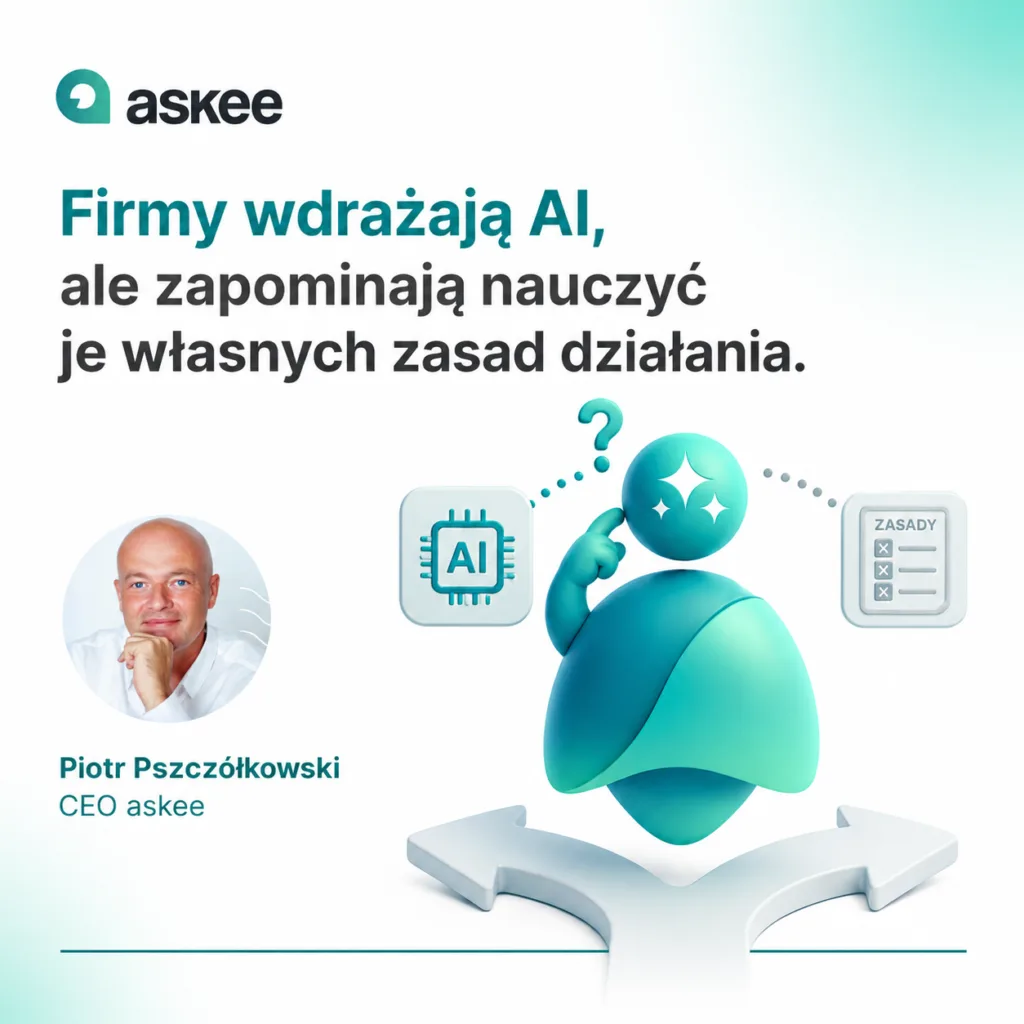
Companies roll out AI but forget to teach it their own operating rules.

Why do most AI rollouts stop at the “suggestion” stage instead of genuinely affecting company results? What makes some organizations see a business impact while others only see better communication? The difference is not the quality of the answers, but whether AI is plugged into real work. If it is to deliver an advantage, it has to connect knowledge with execution – otherwise it remains an intell...


AI used in companies increasingly impresses with the quality of its answers. It explains procedures, summarises documents and suggests possible solutions. It sounds professional, logical and convincing.
But at some point a question appears: does this actually help close cases?
In many organizations AI assistants end their role at the stage of:
👉 an explanation,
👉 a suggestion,
👉 a pointer to a document.
That is valuable but not enough. Business does not run on the logic of “knowledge for knowledge’s sake”. It runs on the logic of outcomes.
McKinsey & Company’s latest report “The State of AI 2025” shows that companies achieving the highest business impact from AI integrate it directly into workflows rather than treating it as a separate information tool. Organizations that stop at the “knowledge assistant” layer are far less likely to report a measurable impact of AI on revenue or productivity.
A similar conclusion comes from Deloitte’s “Global Human Capital Trends 2025” report, which indicates that the greatest barrier to digital transformation is not access to technology but the missing link between knowledge and operational action. In other words – systems that inform but do not lead to a task being completed rarely change how an organization works.
This is the heart of the problem.
In practice a manager does not ask: “what does process X look like?”.
A manager wants to:
✔️ add a task,
✔️ assign accountability,
✔️ check the status,
✔️ close the topic.
The difference is fundamental. It is the shift from information to execution.
That is why askee was designed differently. Not as yet another knowledge assistant, but as part of the working environment.
🔹 It does not just answer questions – it guides the user to closing the case.
🔹 It does not just explain a procedure – it triggers the next steps and walks through them in the right order.
🔹 It does not just point to a document – it works in the context of roles, permissions, projects and active tasks.
This means knowledge, decisions and action are brought together in one place.
Instead of switching systems – context.
Instead of “I will come back to this later” – immediate action.
Instead of open threads – closed cases.
In practice, AI that only explains increases awareness. AI that leads to a task being completed increases operational effectiveness. And those are two entirely different categories of business value.
Mature use of artificial intelligence in an organization is not about knowing faster. It is about working more efficiently and more consistently.
The advantage is not built by the system that generates the best answer.
It is built by the system that helps get the case done.