Artificial intelligence
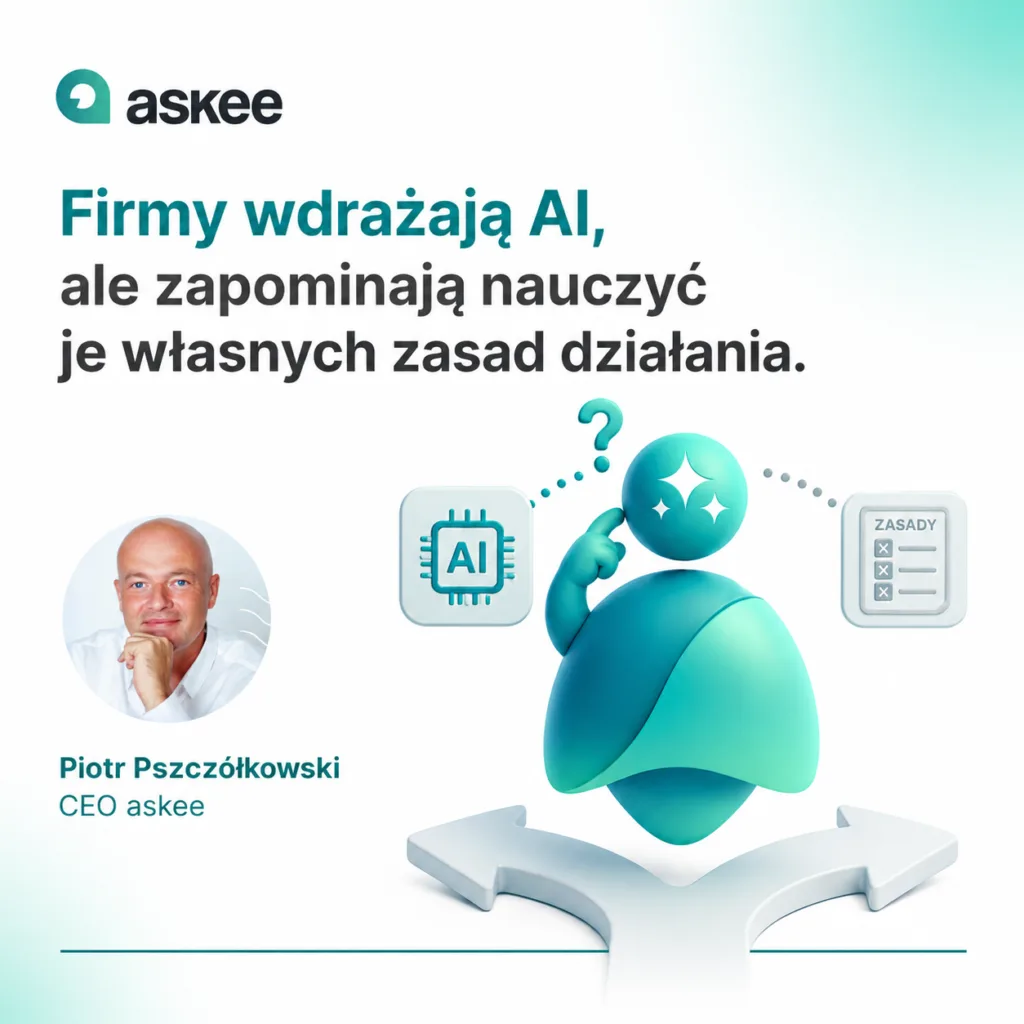
Companies roll out AI but forget to teach it their own operating rules.

AI literacy is far more than the ability to write prompts. It is the ability to assess an AI answer, understand its limitations and consciously take responsibility for how it is used at work.



AI training does not start with prompts – it starts with accountability.
Many companies currently think about AI in a very operational way. You have to roll out a tool, train people, take care of security and see success in the fact that “we have AI in the company”. As a result, the organization arranges prompt training: how to write a better instruction, how to generate an e-mail, how to produce a summary, how to speed up a report.
All of that makes sense, because the quality of the question really does affect the quality of the answer. The problem, however, is that if education stops there, the company is not building competence – it is building an illusion of competence.
So the greatest risk of AI in organizations is not a lack of adoption, because employees do not need extra encouragement to use tools that speed up their work.
The real risk is that AI will be folded into everyday work with no rules, no shared understanding of its limitations and no clear accountability.
Just look at the data – most knowledge workers now use generative AI, often including personal tools, on a “bring your own AI to work” basis. At the same time many leaders admit their organizations have no coherent rollout plan and no clear rules of use.
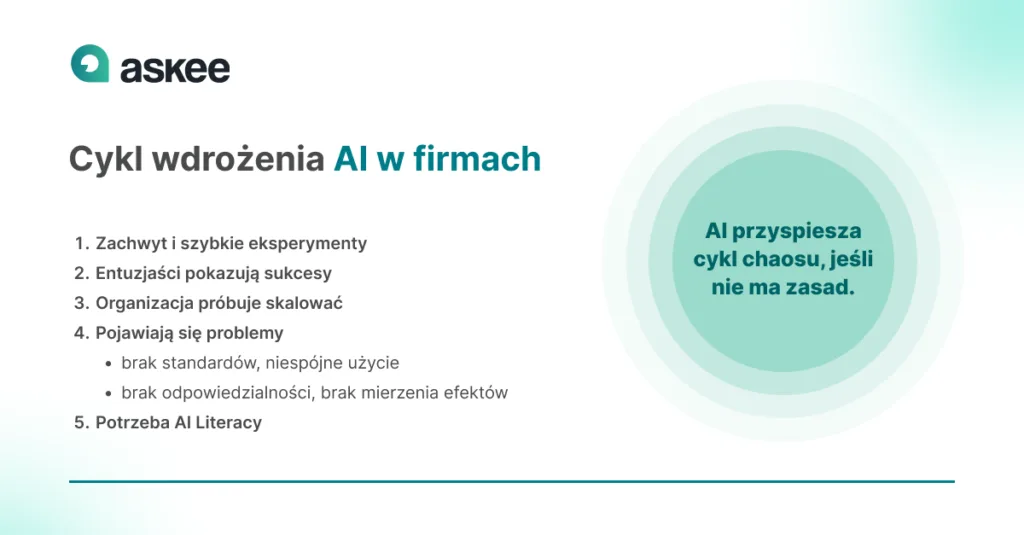
This reveals a certain asymmetry: the technology is developing faster than the organizational culture. Employees learn to use AI by trial and error, while the company is still working out what the standards should be.
People do not bypass processes out of spite – most often they do it because they want to work faster and more effectively. If the official way of working is slow and the unofficial one cuts a task from an hour to five minutes, the second one wins very quickly. Exactly the same thing happens with AI.
In that situation AI literacy stops being a training topic and becomes a management topic.
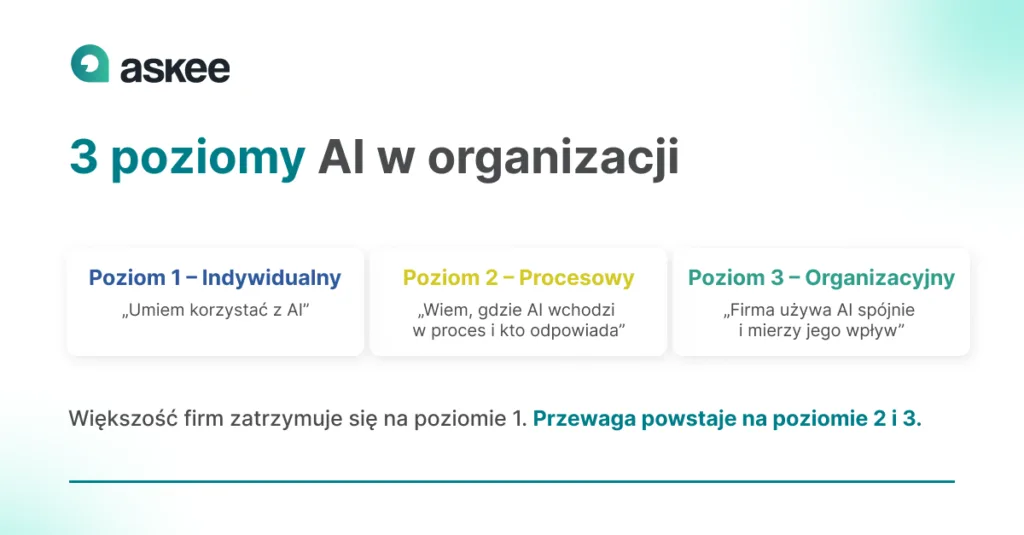
You can use AI and at the same time not roll it out across the organization.
Using it means individual people employ a tool to speed up their tasks. Rolling it out means something far deeper: changing the way work is done, defining roles and accountability, defining the moments at which a model’s output requires human validation, and establishing when the use of AI has to be transparent and documented.
Without that layer an organization can have dozens of tools and still build no lasting value. AI then becomes a catalyst for speed, not quality – and speed without quality can be very expensive.
If an employee uses AI to summarise a document, they should understand that the model may leave something out or simplify it. If they analyse data, they have to know the result depends on the quality of the input. If they generate content for a client, they should be able to assess the risk of error, of conflict with company policy or of disclosing information.
These are not just technical nuances – they are elementary questions of accountability.
AI literacy is therefore not about someone being able to “prompt nicely”. It is about being able to judge when an AI answer is inspiration, when it is a working analysis and when it is a potentially dangerous suggestion. It is the ability to understand the boundary between support and decision.
A specialist drafting an e-mail faces a different risk from an HRBP preparing a development recommendation. A manager making a personnel decision faces different consequences from a board member analysing strategic data.
AI literacy has to be grounded in role and context. Otherwise it will be abstract and detached from real work. And competencies that are not practised in real scenarios disappear very quickly.
Today many people claim to know AI because they have used it a few times. That is like saying you know finance because you can open a spreadsheet. The tool is only the beginning. Competence starts where awareness of limitations, risks and consequences appears.
That is why AI literacy should not end with a certificate. It should end with a change in behaviour. After a good programme an employee not only knows how to ask a question. They also know how to check the answer, how to improve it, how to use data safely and when to take responsibility.
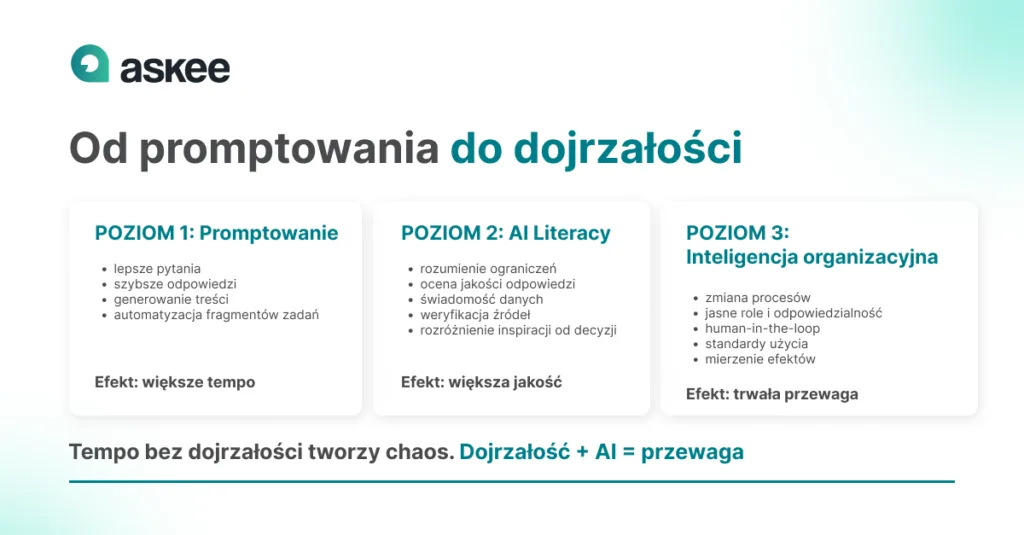
AI changes workflows, the way decisions are made and what is expected of employees. It naturally touches leadership, trust and accountability. That is why AI literacy is not an add-on to digital transformation. It is a condition of it.
Companies that treat it as a one-off training course will build momentary excitement. Companies that treat it as a new organizational competence have a chance to use AI without increasing the chaos.
The future does not belong to those who can prompt most elegantly. It belongs to those who can combine AI with their own judgement and accountability.
AI literacy is not the assumption that “you can use AI”.
AI literacy means that “you can use AI responsibly in a real work context”.