
Artificial intelligence
AI training cannot only teach prompts

Does every AI rollout end in success? The short answer is: no. The longer one – only when the technology is understood, controlled and embedded in real business processes. A few years ago there was wide commentary on the case of Amazon, which tested an AI system for the initial screening of CVs. The algorithm, trained on historical recruitment data, began to favour candidates with a profile simi...



Does every AI rollout end in success?
The short answer is: no. The longer one – only when the technology is understood, controlled and embedded in real business processes.
A few years ago there was wide commentary on the case of Amazon, which tested an AI system for the initial screening of CVs. The algorithm, trained on historical recruitment data, began to favour candidates with a profile similar to those hired previously – which in practice meant discriminating against some applicants. The project was withdrawn. The technology worked in line with the data it was given. The problem was that the data reflected the organization’s earlier biases.
This is a classic example of a situation in which AI did not fail technically – what failed was the understanding of its mechanisms and the absence of appropriate safeguards.
McKinsey & Company’s report “The State of AI 2025” shows that although the share of companies rolling out AI is growing, a significant proportion of projects do not achieve the intended business results. One of the main reasons is inadequate risk management, poor data quality and an underestimation of the organizational impact.
Gartner’s 2025 report, in turn, indicates that a large share of AI projects fail to move from pilot to full operational scale precisely because of problems with data quality, a lack of oversight and a poor fit with real processes.
Case study: automating customer service
In 2024 one of the large telecommunications companies in Europe (the name has not been publicly disclosed in industry reports) rolled out generative AI to handle customer queries. The goal was to shorten response times and reduce call centre costs. Initially the efficiency indicators looked promising – response times fell and the number of queries handled rose.
After a few months, however, a problem appeared. The AI began giving answers that were formally correct but did not take account of specific contract terms and local regulations. As a result the number of complaints rose and some customers escalated matters to the market regulator. The company had to limit the system’s autonomy and introduce additional layers of control.
What went wrong?
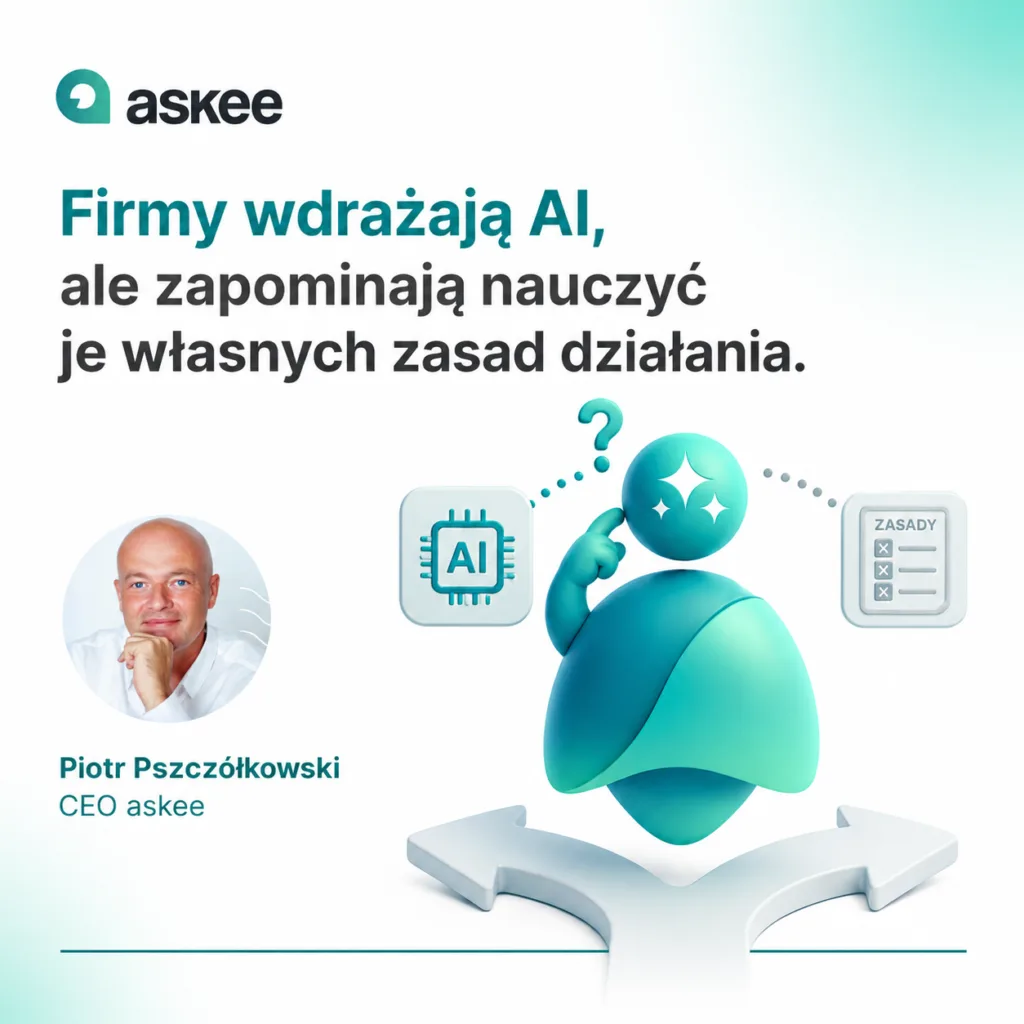
The technology was rolled out faster than the rules for how it should operate were defined. There were no precise rules on the scope of the system’s accountability and no clear oversight of the content of its answers.
IBM’s “Global AI Adoption Index 2025” report stresses that organizations implementing formal AI governance mechanisms (oversight, monitoring, ethical testing) achieve a higher level of trust in their systems and a lower rate of operational incidents. At the same time, companies treating AI as “plug and play” more often experience unforeseen side effects.
The conclusion is simple: AI is a tool, not magic.
An algorithm works on the basis of the data and rules we give it. If the data carries errors or biases – the system will reproduce them. If the scope of accountability is not clearly defined – gaps will appear. If we do not run tests and audits – the risk grows.
That is why the following are crucial in every implementation:
– the quality and representativeness of the data,
– a clear definition of roles and accountability,
– mechanisms for oversight and correction,
– testing in conditions close to real ones,
– readiness to withdraw or modify the solution.
AI can bring enormous value. Reports show that companies rolling it out responsibly achieve real financial and operational benefits. But that value does not appear automatically.
The biggest mistake is believing that because a system “is intelligent”, it will solve organizational problems on its own.
Technology will not replace reflection, ethics and management.
Do you know of other examples where an AI rollout ended in failure? Or perhaps cases where the right approach to testing and governance made it possible to avoid a crisis?
The discussion about AI should not focus solely on what it can do. Boundaries, accountability and a readiness to learn from mistakes matter just as much.